Address
Nanlang Industrial Zone, Xingtan Town, Shunde District, Foshan, Guangdong, China
Work Hours
Mon–Fri, 9:00 AM – 6:00 PM (CST/UTC+8). We aim to respond to all inquiries within 48 hours.

Address
Nanlang Industrial Zone, Xingtan Town, Shunde District, Foshan, Guangdong, China
Work Hours
Mon–Fri, 9:00 AM – 6:00 PM (CST/UTC+8). We aim to respond to all inquiries within 48 hours.
Textile Incoterms Explained: FOB, CIF, DDP & Which to Use. This guide covers key properties, real-world applications, and a practical sourcing checklist for B2B buyers.

A UK importer once paid $4,200 extra on a 20,000-metre knit shipment because the purchase order specified “CIF” without clarifying who bore the port demurrage. Incoterms are not textbook jargon — they are the switches that shift cost, risk, and paperwork between you and your textile supplier. This guide breaks down the terms that actually matter in fabric sourcing, so you can lock the right clause before the next container sails.
At its core, textile incoterms explained simply means understanding the rules that define who pays for what, who bears the risk, and who handles the paperwork in an international shipment. These rules, formally known as Incoterms (the Incoterms full form is International Commercial Terms), are published by the International Chamber of Commerce (ICC) and serve as a common language for global trade. The current edition, Incoterms 2020, is the set you should be referencing in every new contract.
For a textile buyer, these terms aren’t just about cost. They determine your control over the shipment, your exposure to delays, and even your ability to choose your own logistics partners. Getting them wrong can mean unexpected bills, stuck cargo, or voided insurance.
Having managed shipments for over 20 years, we’ve seen how a clear Incoterm clause in a contract prevents 90% of post-shipment disputes. It’s the foundation of a smooth sourcing operation.
What are the 11 Incoterms? They are divided into two groups based on the mode of transport. The first group, “Rules for Any Mode of Transport,” is the most versatile and commonly used in textile sourcing. The second group applies exclusively to sea and inland waterway transport. The following tables provide a quick-reference summary.
| Term | Full Name | Risk Transfer Point | Key Obligation Highlight |
|---|---|---|---|
| EXW | Ex Works | At seller’s premises | Buyer bears all costs and risks from pickup onward. |
| FCA | Free Carrier | Named place of delivery | Seller delivers to carrier; buyer arranges main carriage. |
| CPT | Carriage Paid To | Named place of destination | Seller pays freight to destination; risk transfers at origin. |
| CIP | Carriage and Insurance Paid To | Named place of destination | Like CPT, but seller must obtain insurance. |
| DAP | Delivered at Place | Named place of destination | Seller bears all risks to destination; buyer unloads. |
| DPU | Delivered at Place Unloaded | Named place of destination | Like DAP, but seller also unloads at destination. |
| DDP | Delivered Duty Paid | Named place of destination | Seller bears all costs, risks, and import clearance. |
| Term | Full Name | Risk Transfer Point | Key Obligation Highlight |
|---|---|---|---|
| FAS | Free Alongside Ship | Alongside the vessel at port | Seller delivers alongside ship; buyer loads and bears all costs/risks from there. |
| FOB | Free on Board | On board the vessel | Seller loads goods on board; buyer arranges freight from port of loading. |
| CFR | Cost and Freight | On board the vessel | Seller pays freight to destination port; risk transfers at origin port. |
| CIF | Cost, Insurance and Freight | On board the vessel | Like CFR, but seller must obtain insurance. |
This summary is a starting point. For the definitive legal text, always consult the official ICC Incoterms 2020 rules.
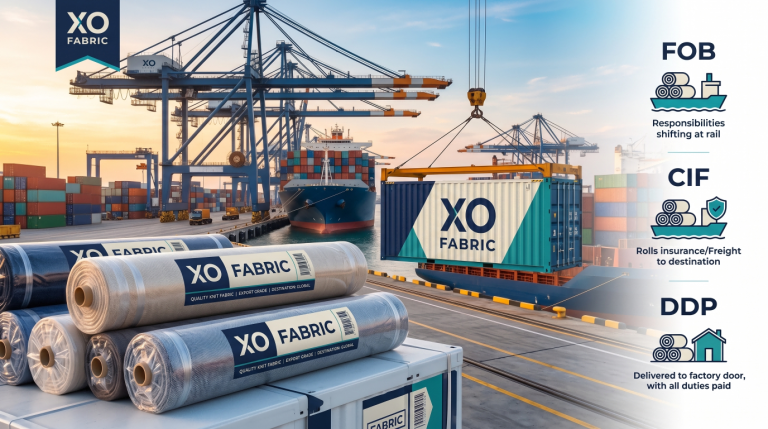
When we talk about textile incoterms explained 2021 and beyond, three terms dominate the conversation for fabric shipments from Asia: FOB, CIF, and DDP. Choosing between them is a fundamental sourcing decision. The table below breaks down their core differences.
| Term | Who Pays Freight | Who Pays Insurance | Risk Transfer Point |
|---|---|---|---|
| FOB | Buyer | Buyer | On board vessel at origin port |
| CIF | Seller | Seller | On board vessel at origin port |
| DDP | Seller | Seller | Buyer’s named destination (e.g., warehouse) |
Let’s ground this in reality. Imagine you’re sourcing 135 Fabric GSM Calculator (4.0 oz/yd²) bright flat cloth, a popular shiny plain jersey. Under FOB Shenzhen, you get the fabric price, then you (or your forwarder) book the container, pay the ocean freight, and handle insurance. You have maximum control and visibility. Under CIF Rotterdam, the supplier quotes an all-in price to the destination port. It’s simpler, but you lose negotiating power over freight rates and may not see the insurance policy details. DDP takes it further—the supplier quotes a door-to-door price including all duties and taxes. It’s the ultimate in convenience.
DDP sounds perfect, especially for buyers new to importing. But it can become a trap. The supplier, now responsible for all risks and costs until your door, will build a significant risk premium into the price—often 10-15% above a transparent FOB-plus-freight calculation. You also lose all control over the logistics chain. If there’s a delay at customs, you’re at the mercy of the supplier’s chosen agent.
I recall a European brand ordering 30,000 metres (≈32,800 yd) of bright flat cloth. They initially chose DDP for simplicity. The shipment was delayed 11 days at Antwerp because the supplier’s forwarder missed an Entry Summary Declaration (ENS) filing. The brand had no recourse and no visibility to fix it. For their next order, they switched to FOB, hired their own forwarder, and while they initially underestimated the inland haulage cost from Shanghai to Ningbo—adding about $0.06/m (≈$0.05/yd)—they gained complete control. Their final compromise was FCA Shanghai, where the supplier delivers the goods to the forwarder’s warehouse, splitting the inland risk. It cost a bit more per metre ($1.48/m vs $1.42/m FOB), but the booking control and transparency were worth it.
This Incoterms explained PDF-style guide wouldn’t be complete without a practical SOP. Choosing the right term isn’t about picking the cheapest quote; it’s about aligning the term with your operational capabilities and risk appetite.
Before you even request a quotation, gather these four inputs:
Follow this decision flow:
Three common mistakes: assuming CIF includes door delivery (it doesn’t; it’s port-to-port), forgetting to budget for local port charges under FOB (THC, documentation fees), and not specifying the Incoterm edition year, which can lead to disputes over which rules apply.
The U.S. International Trade Administration offers a helpful guide on knowing your Incoterms that complements this process.
Your Incoterm choice directly impacts your cash flow, total cost, and even the feasibility of an order. Under Incoterms 2020, the financial timeline shifts dramatically between terms.
With DDP, you typically pay the supplier 100% of the quoted price before shipment. Your capital is tied up for the entire transit plus customs clearance. With FOB, you pay the supplier for the goods and the local charges, then pay your freight forwarder separately—often after the goods are on the water. This can improve cash flow timing.
The landed cost components affected by your Incoterm choice include:
Consider MOQs. A supplier’s stock MOQ might be 500 metres (≈547 yd) per colour. For a small test order, asking for a DDP price might trigger a high surcharge because the fixed costs of arranging door-to-door logistics are spread over fewer units. In such cases, choosing FCA or FOB and using your own consolidated freight service is often more economical. For custom developments with a 1,000-metre (≈1,094 yd) MOQ, the economics of CIF or DDP may become more favorable.
Use this condensed checklist as part of your procurement SOP. It’s the practical, textile incoterms explained pdf you can action today.
Once you’ve worked through this checklist and are ready to discuss specific terms for your knit fabric order, you can use our contact form to request a tailored quotation with FOB, CIF, or DDP breakdowns. Our technical team provides a feasibility assessment within 24 business hours.
You can explore our full range of knit base fabrics to see concrete examples of products commonly shipped under various Incoterms, from basic jerseys to technical performance fabrics.
For small orders, FOB is often better. DDP quotes for low-volume shipments (e.g., 500 metres ≈ 547 yd) can carry a disproportionate logistics surcharge. With FOB, you can use a freight forwarder to consolidate your shipment with others, potentially lowering the per-unit freight cost. You also maintain control over carrier selection and timing.
CIF (Cost, Insurance, and Freight) is for sea/inland waterway only; risk transfers when goods are on board the vessel. CIP (Carriage and Insurance Paid To) is for any transport mode; risk transfers when goods are handed to the first carrier. Both require the seller to insure the goods. DAP (Delivered at Place) is also for any mode; the seller bears all risks to the named destination, but the buyer is responsible for import clearance and unloading. CIP often requires a higher level of insurance than CIF under Incoterms 2020.
Only if you specify them. Incoterms are not automatically updated in existing contracts. If your contract references “Incoterms 2010,” those rules apply. For new contracts, you should explicitly state “Incoterms® 2020” to use the latest edition, which includes changes like the introduction of DPU to replace DAT and updated insurance requirements for CIP.
Under EXW (Ex Works), the buyer is responsible for everything from the seller’s premises onward, including export customs clearance in the seller’s country. This is the maximum obligation for the buyer. In practice, it’s often impractical for foreign buyers to handle another country’s export procedures, so FCA is a more common and practical alternative, where the seller handles export clearance.
Understanding these nuances is part of building a robust sourcing operation. For a deeper look at our company’s history, production capacity, and export certifications that support these Incoterm arrangements, you can review our company profile.
Incoterms are the grammar of international trade. Get them right, and your shipments move smoothly. Get them wrong, and you’re in for a world of unexpected costs and headaches. Don’t treat them as a formality to be copied from a template. Discuss them with your supplier, model the costs, and choose the term that gives you the right balance of control, cost, and convenience for each specific order. The few minutes you spend on this clause can save you thousands of dollars and weeks of frustration down the line.