Address
Nanlang Industrial Zone, Xingtan Town, Shunde District, Foshan, Guangdong, China
Work Hours
Mon–Fri, 9:00 AM – 6:00 PM (CST/UTC+8). We aim to respond to all inquiries within 48 hours.

Address
Nanlang Industrial Zone, Xingtan Town, Shunde District, Foshan, Guangdong, China
Work Hours
Mon–Fri, 9:00 AM – 6:00 PM (CST/UTC+8). We aim to respond to all inquiries within 48 hours.
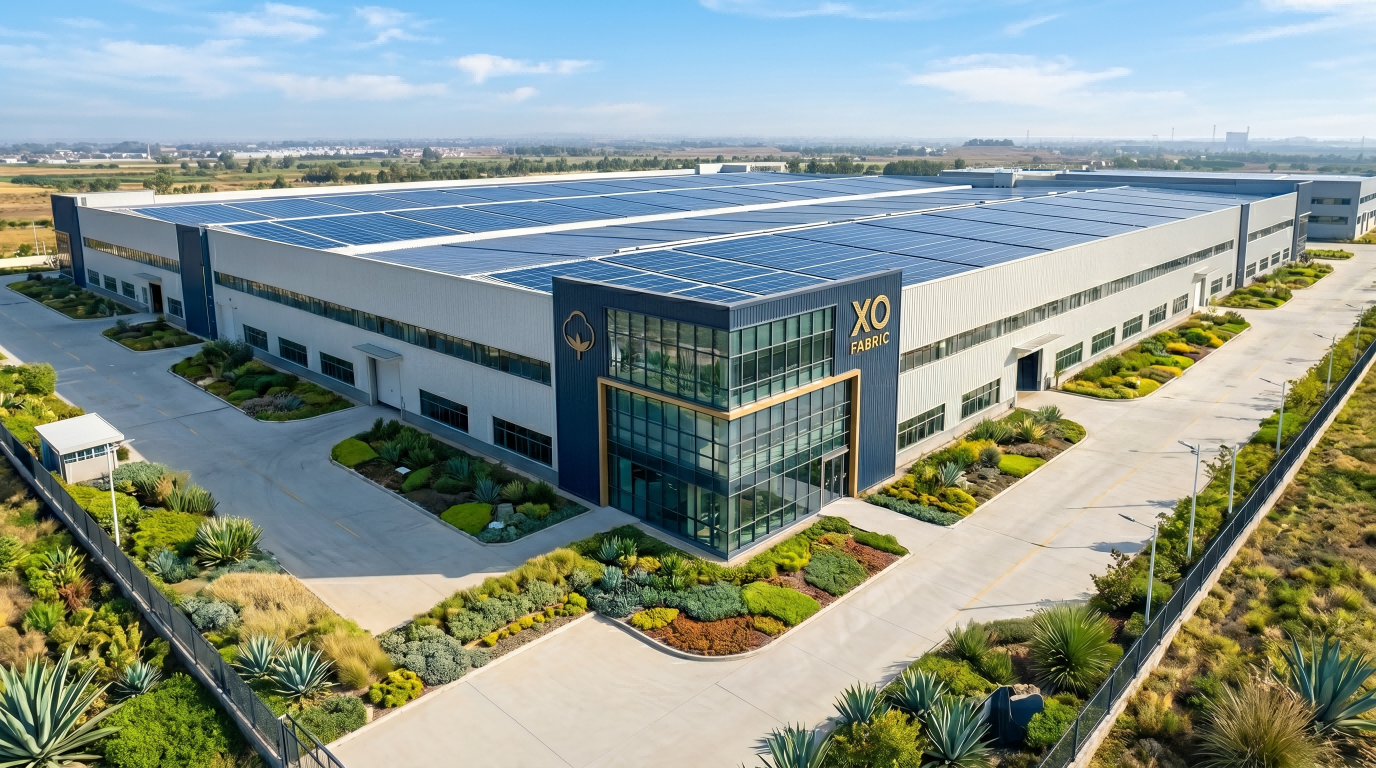
The global textile sector still drags a massive ecological footprint behind it. It accounts for roughly ten percent of worldwide carbon emissions and a staggering twenty percent of industrial water pollution.
It’s a heavy reality to sit with when you’re standing on a production floor, watching rolls of jersey move through the calendar finishers. We knew early on that ignoring those numbers wasn’t an option. That’s why XO Fabric sustainable practices have become the backbone of how we engineer, cut, and ship every yard we produce.
We’re not just checking compliance boxes. We’re actively restructuring how fabric behaves from fiber to final fold. Below, you’ll find exactly how we manage energy, water, and waste, along with the technical trade-offs we make to keep quality high while the footprint stays low. The process is ongoing, honestly, but the trajectory is clear.
Raw material selection dictates everything downstream. It controls handfeel, drape, and how a garment holds up after repeated laundering. We source strictly GOTS-certified organic cotton, which naturally lacks the residual heavy metals often found in conventional crops.
For synthetic blends, we rely on Global Recycled Standard certified polyester spun entirely from post-consumer plastic bottles. Switching to recycled feedstock used to trigger panic over fiber consistency. Modern melting and extrusion techniques have closed that gap completely. You won’t notice a drop in tensile strength or dye uptake when working with recycled polyester compared to virgin yarn.
We pair these fibers with low-impact dyes that require fewer chemical auxiliaries during scouring and mercerization. This shift has noticeably reduced alkaline residue on the fabric surface. It means less harsh neutralizing washes for your production team. All processes fall under strict environmental management protocols, with social accountability audits running quarterly.
We also prioritize local raw material suppliers within a two-hundred-kilometer radius of the mill. This slashes transportation emissions and keeps transit times predictable. Sourcing closer to home means fewer delays when a dye lot needs tweaking or a yarn count requires verification.
This approach to eco-friendly textile manufacturing isn’t just about compliance. It’s about predictable performance. When fibers are grown without synthetic pesticides, the natural cellulose structure remains intact. You get slightly higher absorbency and better moisture wicking in finished knits. I’ve noticed that garments made with this specific cotton blend resist pilling better during early break-in cycles. The fiber walls aren’t micro-fractured by chemical stripping.
We track every batch against strict shrinkage tolerances, usually holding at plus or minus three percent after three wash cycles. Consistency matters more than chasing a zero-impact fantasy that compromises seam integrity or drape. You build your reputation on repeatable yardage, not marketing slogans.
Production floors consume massive amounts of power. You’re running dye baths, steam ovens, and calender machines around the clock. We addressed this through a phased infrastructure overhaul that started with a full LED lighting retrofit back in twenty twenty-three.
The switch wasn’t just about saving on the electric bill. Older halogen fixtures generated significant radiant heat. That heat destabilized humidity levels near the knitting machines. Uncontrolled heat warps knit loops and throws off tension settings. It leads to those frustrating bar wales and irregular gauge counts that ruin otherwise perfect fabric.
LED arrays run cool, keeping ambient temperatures steady so the fabric maintains its structural integrity during high-speed production runs. We also integrated smart HVAC systems equipped with occupancy sensors. They adjust airflow based on actual floor occupancy rather than running on a rigid timer.
Variable frequency drive motors now power every piece of production machinery. VFDs adjust motor speed based on real-time load requirements instead of running at full capacity constantly. This precision control reduces mechanical stress on drive belts. It also minimizes the vibration that often causes needle breakage on circular knitting frames.
In the fourth quarter of twenty twenty-four, we activated a five hundred kilowatt solar panel array on the roof. It currently offsets roughly forty-two percent of total facility energy consumption. The surplus gets fed back into the local grid during peak afternoon knitting shifts when demand naturally spikes.
Monitoring everything in real time is non-negotiable in a modern green factory. Our central dashboard tracks kilowatt-hour draw per machine line. It automatically cuts power to idle equipment after fifteen minutes of inactivity. That single automation tweak slashed standby energy waste by eighteen percent.
I’ll admit, the transition required retraining floor supervisors to stop manually switching breakers. The data speaks for itself, though. Stable energy draw means consistent steam pressure in the dye houses. It directly translates to even color penetration and reduced shading between lots. Predictable power usage just makes the entire workflow smoother and less prone to human error.
Water is the single most volatile variable in textile dyeing and finishing. Too much alkalinity leaves fabrics stiff. Insufficient rinsing traps unfixed dye molecules that migrate later, causing crocking and uneven washfastness. We have to manage it tightly.
Our closed-loop water recycling system captures, filters, and reuses eighty-seven percent of process water directly back into the dyeing and padding stages. The filtration rig uses multi-stage sedimentation followed by reverse osmosis membranes. Those membranes strip out heavy metals and excess salts that would otherwise damage downstream machinery.
| Parameter | Standard Limit | Our Current Output |
| Chemical Oxygen Demand (COD) | Below 100 mg/L | 42 mg/L |
| Biological Oxygen Demand (BOD) | Below 30 mg/L | 11 mg/L |
| Total Suspended Solids | Below 50 mg/L | 18 mg/L |
| pH Balance Range | 6.5 to 8.5 | 7.0 to 7.4 |
We handle all effluent through an on-site wastewater treatment plant that consistently exceeds local EPA discharge limits. Third-party labs run chemical residue testing bi-weekly. Rainwater harvesting supplements our non-process needs, collecting roughly 1.2 million liters annually for landscaping and equipment washing.
More importantly, we’ve fully adopted low-water foam dyeing technology. Traditional immersion dyeing requires high liquor ratios, often between one to eight or one to ten, just to keep fabric submerged and moving. Foam dyeing replaces bulk water with aerated carrier foams that penetrate fibers on contact. This method cuts per-batch water usage by sixty-two percent.
When foam dyeing first hit the production line, we ran into initial issues with foam collapse during the heat-setting phase. If the carrier ratio is off, the foam breaks down too quickly. It leaves streaks across wider fabric widths. We solved it by tweaking the surfactant concentration and adjusting the roller pressure on the pad mangle.
Now, we consistently hit plus or minus two percent color variance. That’s well within industry tolerance for premium knits. Lower water usage doesn’t mean compromised quality. It just means we control the chemistry more tightly. You can actually press foam-dyed jersey at slightly lower temperatures without risking heat damage. That preserves the elasticity of spandex blends remarkably well.
Fabric scrap used to pile up like a silent tax on every production order. We implemented AI-powered zero-waste cutting software in twenty twenty-three. It completely changed how we approach layout optimization. The algorithm analyzes order quantities, fabric width, and grain line requirements.
It then generates nested patterns that reduce scrap by twenty-four percent across the board. It doesn’t just minimize waste. It maximizes yardage yield, which keeps costs stable when raw material prices fluctuate. Small offcuts get donated to local textile recycling cooperatives for insulation and mattress padding.
One major decision point comes when balancing aesthetic matching against material efficiency. A few years back, we worked with a brand developing a color-blocked technical jacket that required three different fabric shades. The initial cutting layout prioritized perfect panel matching, which pushed waste up to nearly twelve percent.
We sat down with their design team and ran three layout simulations. Option one kept perfect matching but bled the budget. Option two allowed slight shade variation on non-visible lining panels, dropping waste to four percent. Option three reoriented the grain line on the sleeve yokes. It saved even more fabric but risked slight drape changes.
We chose option two. We accepted a minimal shade difference on interior seams and preserved both the budget and the structural performance. Compromise isn’t failure. It’s just applied engineering. You have to weigh visibility against efficiency, and then commit to the path that keeps the garment wearable and the production viable.
Packaging used to generate massive plastic waste. We switched entirely to biodegradable cornstarch-based mailers for all customer orders. That change alone has eliminated roughly fourteen tons of single-use plastic since twenty twenty-four. Inside the facility, an employee-led sorting initiative maintains a ninety-two percent recycling rate for office and cafeteria waste.
We track contamination rates weekly. The numbers have steadily improved as staff get used to the new bins. Cutting waste isn’t just about buying smarter software or better packaging. It’s about constantly questioning whether a scrap piece actually needs to be discarded. Every percentage point of reduced waste directly lowers the cost per wearable unit.
Looking ahead, we’ve mapped out concrete targets that align environmental responsibility with long-term production viability. By twenty twenty-seven, we aim to achieve zero liquid discharge across all processes. That means one hundred percent of wastewater will be recycled or evaporated on-site.
This shift will require advanced membrane bioreactors and thermal evaporation units. It eliminates the risk of regulatory penalties and stabilizes water costs during drought periods. Reaching full independence from municipal water supplies also means we can guarantee consistent fabric quality. Regional drought conditions or seasonal fluctuations won’t throw off your production schedule anymore.
The twenty twenty-eight target focuses on running the entire operation on one hundred percent renewable energy. We’ll expand the existing solar array and procure regional wind power contracts to cover any generation gaps. Energy independence stabilizes overhead costs, which is crucial when raw material pricing becomes volatile.
By twenty thirty, we commit to carbon neutrality across Scope one, two, and three emissions. It will be verified independently by a third-party auditor. Scope three is always the hardest to tackle. It includes supplier logistics and end-of-life disposal. Transparent tracking is the only way to manage it effectively. We’ll publish annual impact reports so partners can verify our progress.
By twenty thirty-two, every textile we produce will follow a fully circular model. It will be designed to be either industrially recyclable or safely home-compostable. This means phasing out mixed-fiber blends that can’t be mechanically separated. We’ll move toward mono-material constructions wherever possible.
It’s a significant shift for sustainable production, but it aligns with emerging extended producer responsibility laws. Designing for disassembly early in the development phase actually simplifies manufacturing later. You spend less time troubleshooting adhesive failures or complex seam constructions. You spend more time refining handfeel and drape. The roadmap is ambitious, but it’s built on incremental engineering improvements rather than vague promises.
Integrating these standards into your own product line doesn’t require a complete overhaul of your design process. It starts with selecting materials that already meet rigorous environmental benchmarks without sacrificing performance. You don’t have to reinvent the wheel to lower your impact.
We encourage designers to place bulk orders for our eco-friendly performance knits. They combine recycled feedstocks with moisture-wicking finishes that hold up under heavy use. You can explore the full range at Performance Functional Knits, where each item includes detailed technical specifications and care instructions. Sourcing from a consolidated category simplifies compliance reporting.
Custom finishing options also play a major role in reducing environmental impact. Many brands still rely on traditional fluoropolymer treatments for weather protection. Those compounds break down into persistent microplastics and bioaccumulate in water systems. We offer a water-resistant coating finish formulated with low-VOC, PFAS-free chemistry. It delivers reliable bead-up performance while remaining fully biodegradable.
The application process uses precision spray pads that limit chemical uptake to exactly what’s needed. It reduces runoff and simplifies post-treatment washing. You get the same hydrophobic performance without the ecological baggage. Shipping logistics represent a large chunk of your overall carbon footprint, which is why we provide optional carbon-neutral shipping for every order.
We calculate emissions based on weight, distance, and transport mode. We then issue digital offset certificates upon request. This transparency makes it easier for your marketing team to communicate genuine sustainability metrics to your end customers. If you’re looking to develop an exclusive line tailored to specific ESG targets, we’d love to discuss your roadmap. Reach out and contact our team to start building a collection that aligns with your vision.
Sustainability in textiles isn’t a marketing checkbox or a temporary trend. It’s a continuous engineering exercise that balances material science, operational efficiency, and honest trade-offs. When you understand how water chemistry affects dye fixation, how energy stability prevents knitting defects, and how layout optimization preserves both budget and quality, the choices become clearer. The goal isn’t perfection. It’s measurable progress that doesn’t compromise the fabric you actually need to build with. Keep questioning every input, track the data closely, and let the numbers guide your next season.